Leading up to the Convergence
The Housing Justice Convergence began with a simple question: How can we bring together organizations using different strategies to address the housing crisis and strengthen their collective capacity for change?
Recognizing that tenant unions, housing co-operatives, advocacy groups, researchers, and grassroots movements were often working toward shared goals through different approaches, SEIZE launched From Crisis to Consensus, a national research initiative to identify common challenges, priorities, and opportunities for collaboration.
We reached out to 120 housing organizations across Canada, receiving 60 survey responses that informed the report's findings and recommendations.
To bring these findings back to the movement and into the public conversation, we organized two report launch events: a community feedback session, where participating organizations could discuss and reflect on the findings, and a press conference, where housing advocates presented shared concerns and proposed solutions to the media.
The press conference generated coverage from major news outlets, including Global News, CTV Montreal, CityNews, and Noovo Info, helping amplify the perspectives of grassroots housing organizations and bring greater public attention to their collective demands.
Following the report's launch, participating organizations were invited to continue the conversation through a Housing Working Group, creating the foundation for the organizing committee that would go on to shape the Housing Justice Convergence.
From Crisis to Consensus
SEIZE conducted a national survey of tenant union organizers, advocacy groups, and community organizations. The views expressed in the report diverge sharply from the loudest opinions on the housing crisis. Groups directly representing people at the front-lines of the housing crisis have been largely missing from the opinion columns, policy announcements and blue-ribbon panels that attempt to address the housing crisis.
Some of the key findings about these groups’ policy views include:
- A consensus of the groups favours publicly-funded social housing
- A strong majority support direct action to protect or improve access to housing, including 80% support of rent control policies
- A near-consensus supports financing non-profit housing and cooperatives
- The only policy measure that received strong opposition was government incentives for private rental housing
Read the report:
The Start:
Following the launch of From Crisis to Consensus, SEIZE invited organizers to continue the conversation through a Housing Working Group. The goal was to build on the shared challenges and priorities identified in the report and create a space for organizations pursuing different approaches to housing justice to explore opportunities for collaboration.
Through a series of focus group discussions, participants helped identify the diverse perspectives, strategies, and issues that should be represented at the Housing Justice Convergence. These conversations helped shape the gathering's themes and priorities, ensuring that its programming reflected the needs and experiences of people actively organizing around the housing crisis.
From this process, a smaller Housing Justice Convergence Organizing Committee emerged to take responsibility for coordinating and bringing the gathering to life. Building on the direction established through the working group, the committee developed the program, coordinated speakers, participating organizations, and managed the planning and logistics needed to make the convergence happen.
The HJC organizing committee included Stefan Christoff, Aylse Tunnell, Olivia Champagne, Dru Oja Jay, Malcolm McClintock, Hannah Ostiguy Hopp, and Maeve Brennagh-Mackie.
Interviews
The Convergence
From March 7–9, 2025, the first-ever Housing Justice Convergence brought together over 280 participants from coast to coast for three days of learning, strategizing, relationship-building, and collective action.
The convergence brought together tenant unions, housing advocacy organizations, co-operative housing practitioners, researchers, artists, and grassroots organizers pursuing different but complementary strategies to address the housing crisis. Rather than focusing on a single solution, the gathering explored how grassroots organizing, direct action, policy advocacy, and community-owned housing alternatives could complement and reinforce one another.
Supported by 10 organizations, 36 community partners, and over 20 volunteers, the program included:
9 panel discussions exploring housing decommodification, displacement, tenant power, and democratic housing alternatives.
4 workshops offering practical skills, creative expression, and tools for organizing.
4 special interest caucuses creating space to exchange strategies, identify shared needs, and explore opportunities for collaboration.
3 walking tours, including an anti-gentrification tour and a tour highlighting community land trusts and co-operative housing.
4 networking gatherings and 2 social events fostering relationships and community beyond the formal programming.
The convergence also connected political education with collective action, moving beyond discussion and into the streets. On March 8, HJC participants formed their own contingent and joined Montréal's International Women's Day protest, bringing intersectional housing justice issues into the broader feminist mobilization. Importantly, the convergence was more than just a gathering of like-minded people. It created opportunities for people working across different strategies to recognize their shared goals, build relationships, and identify common challenges and gaps in the infrastructure needed to sustain their work.
In the Media:

Montréal Unites for Housing Justice
CUTV • Video
A video interview series with speakers, organizers, and attendees of the Housing Justice Convergence - shot during the conference itself!

To win housing justice, we have to ‘get profits out of the equation’
The Breach • Article
A video interview series with speakers, organizers, and attendees of the Housing Justice Convergence - shot during the conference itself!

Off the Hour
CKUT • Discussion
A LIVE panel discussion at the Housing Justice Convergence, moderated by Stefan Christoff of Free City Radio.

Funky Revolutions
CKUT • Discussion
Funky Revolutions is based on the One. Since 1994, host Khalid and guests have invited you to groove & celebrate the history of Africana music - the African diaspora and its musical reflections around the world. This is another program dedicated to social justice, housing, and cultural spaces live from the Housing Justice Convergence.

Interviews with panelists, attendees, and more:
What's Next
The convergence was both a celebration of the housing justice movements already building power across the country and a commitment to strengthening our collective capacity to meet its escalating challenges. By connecting different strategies, surfacing shared needs, and building relationships across organizations and movements, it helped lay the groundwork for greater coordination, solidarity, and collective action beyond the gathering itself. The ripple effects of these connections continue to be felt today, as the relationships, ideas, and opportunities that emerged from the convergence continue to shape our collective work toward housing justice.
Surfacing Shared Priorities & Needs
Throughout the convergence, participants were encouraged to reflect on the challenges facing their organizations, identify common priorities, and explore opportunities for greater collaboration.
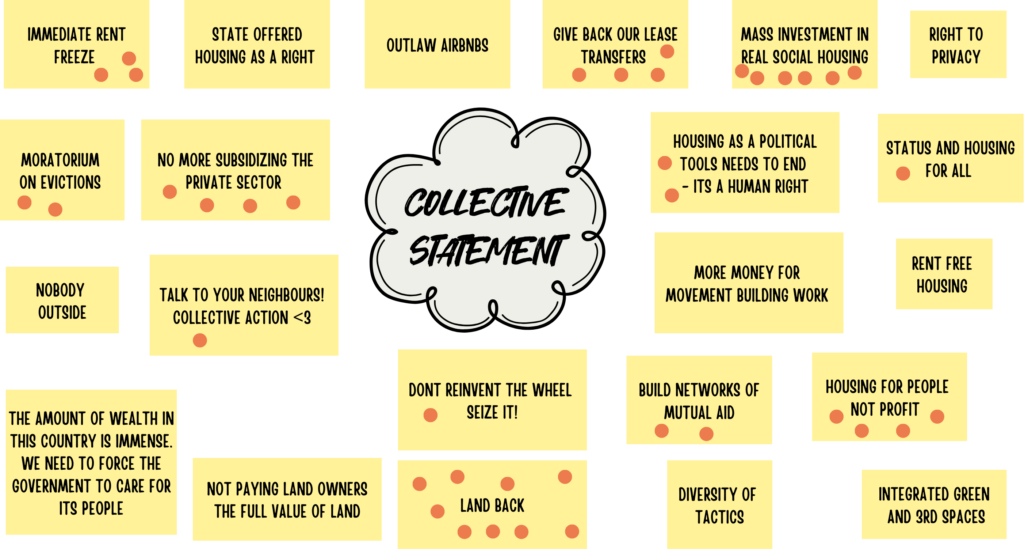
One way we gathered these perspectives was through a collaborative Dotmocracy exercise, where participants could contribute ideas on shared priorities and demands, respond to suggestions from others, and vote for those they most strongly supported. Alongside the discussions that took place in panels, workshops, and caucuses, this exercise helped surface areas of alignment across organizations pursuing different approaches to housing justice.
These conversations also reinforced the importance of investing not only in individual campaigns and organizations, but in the shared resources, relationships, and infrastructure that enable movements to build power collectively.
Continuing the Work
One of the most important lessons from the convergence was that bringing movements together is only the beginning. Sustaining collective action requires ongoing relationships, shared resources, and structures that enable organizations to work together over time. Check out Canada's largest housing justice directory here to see where you can take action to make connections today!
Since the convergence, SEIZE has continued working to strengthen connections between tenant unions and housing co-operatives, with a particular focus on developing pathways for tenant organizing to evolve into collective property ownership through housing co-operatives & community land trusts. This work remains ongoing, building on the relationships and opportunities for collaboration that emerged from the convergence.
The Housing Justice Convergence was one moment in a much longer struggle, but the connections it created continue to open possibilities for what we can build together.